

Branch Banking in a Multichannel World: What Ever Happened to the "Branch of the Future?"
Abstract
Even though the majority of financial institutions surveyed indicate that improving branch sales and service performance is their top branch channel priority, few have invested in technology to help realize that goal.
In a new report, Branch Banking in a Multichannel World, Celent explores the current state and likely evolution of North American branch technology infrastructure. The current branch technology environment at most financial institutions is basic and largely non-automated at an unsustainable level. This does not include pilots or proof of concept activity:
Less than a third of surveyed financial institutions (28%) have operational CRM systems, and fewer still have analytic CRM (23%).
Account opening remains largely manual, with just 29% enjoying automated, paperless systems. Loan origination is similarly manual and relies on the movement of paper, with just one in five banks having automated systems.
Cash handling requires dual control, largely manual work at most financial institutions. Only a fourth of surveyed financial institutions use teller cash recycling. Those that do typically limit usage to only the most cash-rich branches.
The smallest institutions have more modern core systems, but less automated branch networks. Midsize and large institutions operate multiple systems and are in need of platform consolidation prior to investing in more sophisticated branch automation systems. Larger institutions have been more apt to invest in transaction automation. More glaring differences arise between banks and credit unions. Credit unions have a distinct lead over banks thus far in terms of branch automation solution usage.
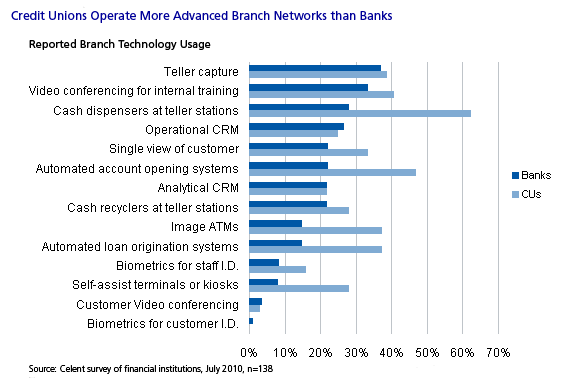
“Most financial institutions are under considerable pressure to both reduce costs and improve branch sales and service effectiveness,” says Bob Meara, Senior Analyst with Celent’s Banking Group and author of the report. “Credit unions appear to be way ahead of banks in terms of having invested in technologies to help bring this about. Banks have lots of catching up to do.”
The report begins by outlining the increasingly challenging retail banking business environment in North America and analyzes reported multichannel and specific branch channel priorities. The report provides an analysis of the current state of branch channel technology and physical environments. It then takes a predictive look at the midterm branch technology environment based on surveyed technology direction and adoption intent. Lastly, the report looks forecasts the likely evolution of North American branch banking over the next five years.