



Community institutions must be deft purveyors of modern financial services. Banking is no longer a simple business, and the complexities and modern requirements are overwhelming those without the scale to meet new challenges. The past 10 years have seen the rise of Internet banking and bill pay, mobile banking, know your customer (KYC), Office of Foreign Assets Control (OFAC) compliance, consumer and business remote deposit capture, branch capture, and much more.
Most small institutions don’t have the resources to stay on top of it all, and the requirements to “keep the lights on” leave pockets dry for modern customer-facing applications and services that have become crucial to growing deposits. Within this environment, smaller institutions are declining.
In the report And Then There Were None: The Disappearance of Community Banks, Celent looks at the trends affecting consolidation of banks in the US. The report begins by tracking the trends within six asset tiers. The report examines the growth of deposits, followed by efficiency ratios, and concludes with insight and recommendations for banks going forward.
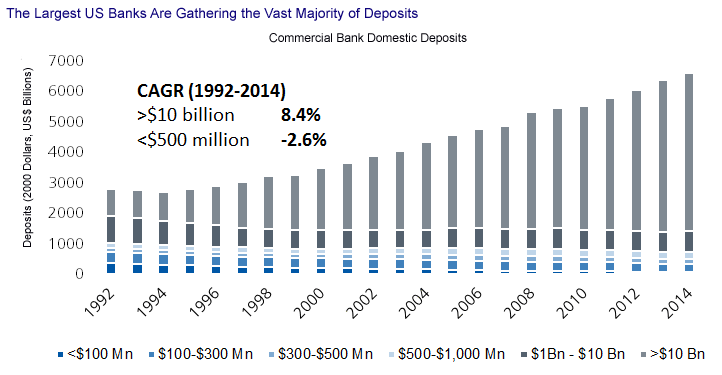
The past 20 years have shown continued concentration in the commercial banking space in the US, with banks with more than $10 billion in assets dramatically gaining deposit share. Today the top five banks in the United States have nearly 40% of all domestic deposits.
The number of commercial banks in the US is declining rapidly, from 11,462 at the end of 1992 to 5,809 in 2014. Celent predicts the total will drop to 4,942 by 2019, a compound annual growth rate (CAGR) of –3.1%. The vast majority of this consolidation is taking place in the smallest commercial banks, those with assets less than $100 million.
“To survive in this new era of digital banking, small institutions need to adapt. Consumers can now have banking relationships that never leave a mobile device,” says Stephen Greer, an analyst with Celent’s Banking practice and author of the report. “Many may take advantage of attractive loans from a community institution, while keeping deposits with a bank that enables cutting-edge digital capabilities like bill pay, transfers, and payments.”