



Celent analyzes architectural underpinnings, operating models. and market solutions that can enable sustainable future state capabilities for enterprisewide stress testing.
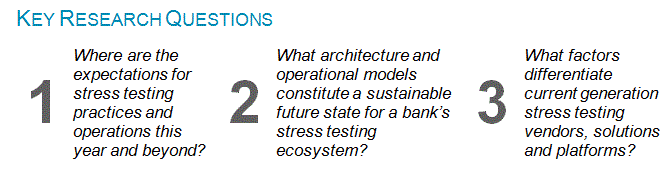
Regulatory stress testing exercises in Europe, the US, the UK, and other jurisdictions have been executed over the past few years with great trepidation and strain. Banks have scrambled to get their annual submissions up to speed and are making big strides. However, these have been achieved with significant pain and costs. In Stress Testing Solutions 2016, Part 1: Future Architectural Best or Architectural Mess?, Celent examines the future of stress testing operating models and the solutions that will shape its evolution in the coming years.
Despite the progress made to date by institutions, Celent expects regulatory stress testing regimes globally to continue to evolve towards “tests,” becoming more difficult each year. Regulators are continuing to ratchet up expectations around the process and its sub-components. The underlying paradigm is one of “looking under the hood” of the stress testing machinery to ensure that its underpinnings are sound.
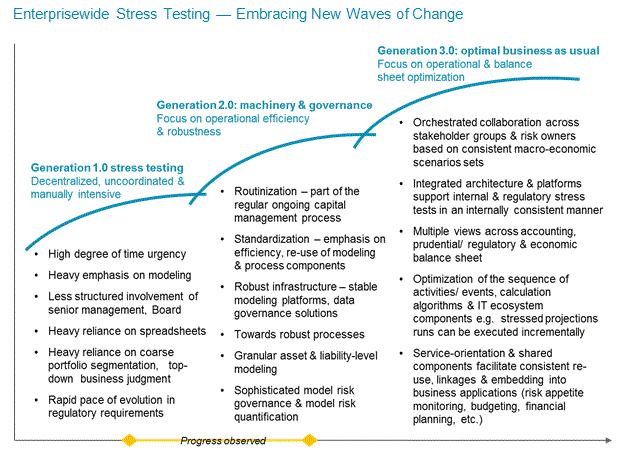
In observing industry developments to date, financial institutions that are on the frontier of firmwide stress testing activities have undergone several waves of change — in terms of the evolution of operational and technology capabilities to deliver to regulatory submissions, streamline stress testing production activities, and assimilate its implications on broader budgeting and planning processes.
“We believe firms still have to reassess the choices that they have made, or perhaps fallen into, through historical decisions,” says Cubillas Ding, a research director with Celent’s Securities & Investments practice and author of the report. “Institutions will need to make new choices in order to support requirements for a more sustainable operating model enabled by stronger architectural cohesiveness.”
As firms normalize stress testing activities on a business-as-usual basis, architectural foundations need to be put in place and seeded for future value-added capabilities. In the longer-term horizon, as processes and infrastructure are being constructed and enhanced, banks would do well to ask themselves: “Is our risk and stress testing infrastructure fit for purpose merely to address compliance requirements, or does it need to do more to help us budget, plan, and optimize our balance sheet in a dynamic manner?” Without a firm architectural foundation for technology and operations, the latter could be stifled.
This report, the first installment of a series, explores emerging architectures, operating models, and solutions required to achieve sustainability, consistency, and repeatability of stress testing capabilities in the longer term. Another report will evaluate vendors using Celent’s ABCD vendor view.
This 26-page report contains 12 figures and tables.