

Artificial intelligence is fundamentally redefining the nature of work across all organisational levels. As machines increasingly assume responsibility for routine activities and process vast volumes of data at unprecedented speeds, a notable reality is emerging: the integration of advanced technologies is reshaping the role of humans in enterprise value creation. Within this evolving context, Agentic AI has emerged as a pivotal force, transforming workforce composition, occupational roles, and the skillsets required for sustained competitiveness. Unlike traditional automation, Agentic AI operates with a degree of autonomy, enabling independent decision-making and action without continuous human supervision. This development constitutes not a mere technological enhancement, but a structural transformation in labour organisation, productivity paradigms, and underlying economic models.
From Task Executors to Orchestrators of Value
The traditional role of employees as task executors is giving way to a new paradigm where they become orchestrators of value. This transition is driven by the need for businesses to enhance productivity and output without proportionately increasing headcount. The productivity gains from AI are compelling. Workers using generative AI report saving significant time each week, translating into overall productivity increases. AI's impact extends beyond time savings, enhancing decision-making capabilities and enabling more informed, efficient, and strategic decision-making. Human employees are increasingly collaborating with agentic AI counterparts to complete complex tasks, with these partnerships rapidly transforming workplace dynamics across industries. AI also transforms leaders' workflows by automating repetitive tasks, allowing them to focus on innovation, strategy, and the uniquely human aspects of leadership. Predictive analytics enables leaders to anticipate market trends and customer behaviours with greater accuracy, supporting real-time adaptive forecasting.
Emerging Leadership Landscape
The leadership landscape is shifting as AI reshapes how decisions are made and strategies formed: intuition-led strategy is evolving into AI-augmented decision-making that preserves human insight while amplifying it with predictive models and pattern recognition; static quarterly planning gives way to real-time adaptive forecasting that continuously ingests new data to update priorities and resource allocation; and gut-based decisions are being complemented by data-informed judgment, where leaders blend experience and context with analytics to make faster, more accurate choices. Together, these changes create a new leadership paradigm that balances human creativity and ethical reasoning with machine-scale intelligence to navigate complexity and accelerate organisational learning.
Reskilling and Upskilling: A Strategic Imperative
Organisations must treat reskilling and upskilling as strategic imperatives in sustaining workforce relevance and competitiveness. Reskilling entails acquiring entirely new capabilities aligned with emerging job requirements, while upskilling focuses on enhancing existing competencies through targeted learning and development initiatives. Artificial intelligence can itself catalyse this transformation, enabling human resource functions to identify and prioritise critical future-facing skills in recruitment, talent management, and promotion decisions. Moreover, AI facilitates the creation of personalised, adaptive learning pathways, transforming employee development from a traditional HR function into a strategic driver of business growth. Notably, even before the widespread adoption of AI, empirical data indicated that employers increasingly valued emotional intelligence over cognitive intelligence—a trend expected to intensify as AI continues to augment technical and analytical capabilities.
Leading the Transition
The shift to an AI-driven workplace is underway, not in the distant future. Organisations adopting AI are automating decision-making at scale, and the use of AI agents is expected to grow substantially in the coming years. Successful leadership in this era will blend technological expertise with uniquely human judgment, designing organisations around augmented intelligence so humans and AI agents collaborate seamlessly.
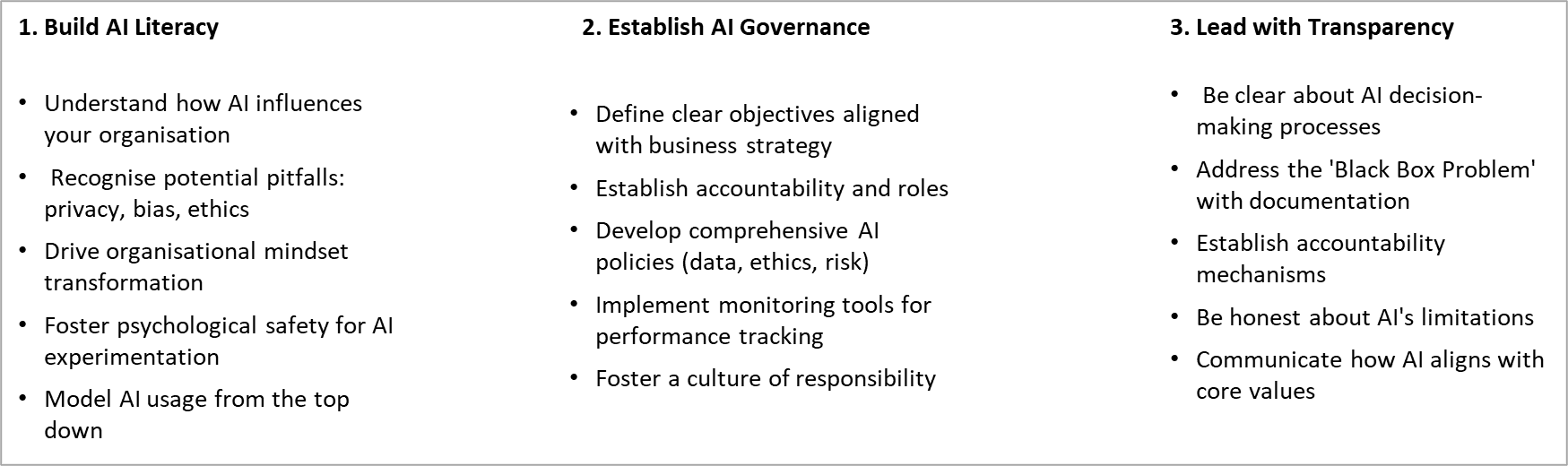
As leaders navigate this transformation, they must balance innovation with accountability, efficiency with empathy, and technical capability with human values; those who do will steer their organisations toward greater performance, resilience, and meaningful impact. Their immediate priority should be to deliberately design organisations for augmented intelligence: restructure teams to enable seamless human–AI collaboration, institute robust governance and accountability to manage risk and ethical use, and embrace AI-augmented decision-making that pairs machine insight with human judgment. Equally important is fostering cultures of transparency, psychological safety, and trust so employees feel empowered to work with intelligent systems and sustaining investment in continuous upskilling and lifelong learning to keep skills current as tools and techniques evolve.