

• Contact us
      • Contact Us
      Have a question?
      Try speaking to one of our experts
      Contact us
      Information
      • Careers
      • Privacy Notice
      • Cookie Notice
      • Terms of Use
      • Office Locations
      Sign up for industry updates
      Stay up to date on Celent's latest features and releases.
      Sign up
      • Privacy Notice
      • Cookie Notice
      • Terms of Use
      REPORT
      Robotic Process Automation in Risk and Compliance
      Benefits, Challenges, and Use Cases
      7th August 2018
      //Robotic Process Automation in Risk and Compliance

      There are an abundance of tasks across risk and compliance operations that can be automated using robotics. But early implementations are not providing the expected results. The disappointment with early implementations is not a reflection of RPA as a technology. Rather, it is a lack of good governance and advance planning.
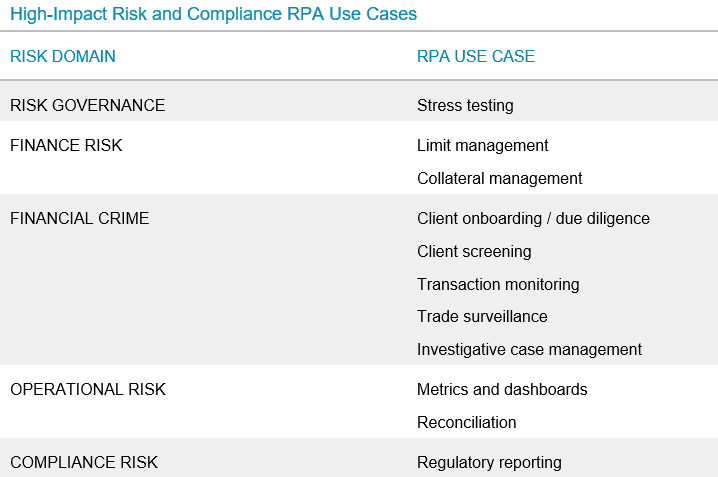
      A typical bank employee makes 10 to 30 errors per 100 opportunities. Now consider a top UK-based global financial institution that employs 12,000 fraud anti-money laundering (AML) and compliance analysts. The math is alarming. RPA, as a set of technologies that enables the automation of tasks currently requiring human involvement, is a compelling business approach to the problems of staffing, risk mitigation, and the management of compliance.

      Details
      Geographic Focus
      Asia-Pacific, EMEA, LATAM, North America
      Horizontal Topics
      Risk: Operational Risk Management
      Industry
      Corporate Banking, Retail Banking