



Growth in trading new asset classes and markets amidst constant evolution in post-trade infrastructure and market practices call for more efficiency and agility in back office systems. Containing costs and improving return on equity in the long run will require major transformation of current fragmented and siloed post-trade practices.
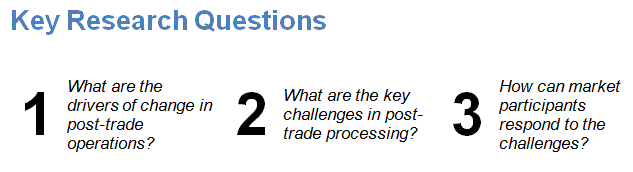
In the report Top IT Trends in Post-Trade Processing: Insights and Implications, Celent discusses several challenges plaguing post-trade operations of capital market firms, and proposes key solutions and strategies needed to respond to them.
Advances in front office technology over the last decade have not been matched by back office automation with post-trade processing still mired with legacy systems, and batch processing that requires manual intervention. This is resulting in inefficiencies which are proving to be bottlenecks.
The level of automation in post-trade is still suboptimal at many capital market firms. There is a clear need for rationalizing platforms in the front office and streamline post-trade operations to achieve a unified back office spanning asset classes. Meeting these challenges under severe cost constraints can be difficult, especially when more than 75% of budgets are being spent just on running the bank. Radical cost reduction programs such as mutualization and shared services could help financial institutions achieve their goals while keeping costs low.
“To improve their post-trade operations, capital market firms have several options to choose from, beginning with the incremental and quickly achievable goal of more automation and outsourcing, through to adopting more ambitious and innovative solutions like robotics and distributed ledger technologies,” says Arin Ray, an analyst with Celent’s Securities & Investments practice and author of the report, “There is a strong desire across the spectrum to outsource as many noncore processes as possible, including the complete back office, which should pave the way for greater adoption of managed services and utility solutions in the medium term.”
This report examines the evolution of IT and operational issues in post-trade processing. We discuss the key forces driving changes in the capital markets and analyze how they are impacting post-trade operations. We identify the shortcomings with current practices and outline key themes and trends that are emerging as firms prepare to respond to industry challenges.