



Paris, France 4 December 2008
Freight Derivatives: The Beginning of the End or the End of the Beginning?
The economic slowdown has slowed the growth of the freight derivatives industry. However, there is reason to believe that the market will pick up by the middle of 2009.
The freight derivatives market has been touted as the next big thing that could allow financial players to balance their portfolios, emerging as an asset independent of the commodities desk. In a new report, Freight Derivatives: The Beginning of the End or the End of the Beginning?, Celent analyzes how the freight derivatives industry has evolved. It looks at the potential impact of the current crisis on the shipping market as well as the long-term prospects for investors looking to enter the market.
The underlying shipping market had been experiencing a boom, with massive growth in freight prices. However, the state of the global economy has decreased the demand for freight transportation. "The volatility of spot freight has traditionally been high. This has been exacerbated by the current economic climate," says
Axel Pierron, Celent SVP and co-author of the report.However, volumes of the main exchange, Imarex, and clearinghouses such as LCH.Clearnet have remained steady. Currently, the value of the derivatives market is US$125 billion, while the spot market is around US$150 billion. The derivatives market may soon overtake the underlying physical freight market.
The forward freight agreement (FFA) market, the main freight derivatives, has matured. Cleared OTC and exchange-traded FFAs have now overtaken non-cleared OTCs. This evolution is driven by market participants’ concerns regarding counterparty risk. However, this also underlines the potential for the FFA to become a more common part of investors portfolios. Indices such as the Baltic Dry Index will becomeimportant elements in evaluating the market’s potential on a regional basis.
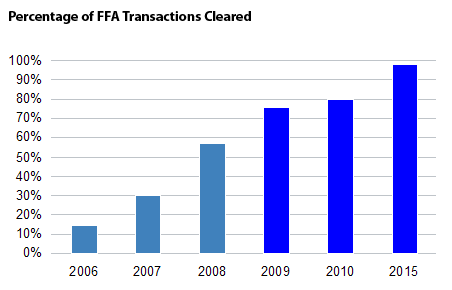
The international FFA market has recently begun to show signs of maturity and depth. Part of the reason for this is the increasing participation of commodity traders and finance companies such as banks, mutual funds, and hedge funds. Non-shipping participants currently represent a majority of the FFA dry market.
"While there has been some resistance among original market participants to excessive participation and speculation by outside players, their participation is generally constructive, because it helps to deepen the market," says
Anshuman Jaswal. "As a result, a greater number of price points are generated, providing liquidity in the marketplace." The share of financial participants in the market has risen from 15% in 2007 to 40% in 2008.In this report, Celent provides a detailed analysis of the shipping industry, evaluating the danger of over-supply and the impact of the current economic crisis. It then examines the structure and drivers of the freight derivatives market (e.g., market participants, pricing mechanisms, etc.). Finally, the report gives an overview of the major trading platforms and IT solutions serving the FFA market.
A table of contents is available online.
of Celent's Commodities research service can download the report electronically by clicking on the icon to the left. Non-members should contact info@celent.com for more information.