



Celent provides perspectives for financial firms and technology providers to find better ways to exploit real-time capabilities for dynamic management of risks.
Real-time risk management is not necessarily new or cutting edge, but it has yet to reach its potential. In part two of a series, Back to the Future in Risk Management: Realizing the Full Potential of Dynamic, Real-Time Capabilities, Celent examines trends, strategies, and industry case studies of firms pursuing a more dynamic paradigm for managing risks.
Since 2008, top 20 European banks have increased their capital requirements by more than €300 billion, top US banks in excess of $175 billion. Penalties, losses, and litigation impact from compliance breaches, conduct failures, cybersecurity threats, and sub-second “flash crashes” are becoming conundrums, resulting in costs in excess of $150 billion last year alone.
Continued demands of regulatory rules on capital, conduct, and risk appetite mean that firms will increasingly require business decisions to be weighed at the point of transactions in relation to risk/return characteristics, towards pre-trade, real-time frameworks in order to achieve capital efficiency for front office lending, trading, and hedging activities. Emerging market structure and supervisory frameworks implicitly embed dynamic, often real-time requirements for information and data.
Despite implicit pressures and progress across various sectors, the path to a real-time paradigm remains patchy. Discussions with financial firms often indicate that the business case often does not stand on its own but is done in tandem with characteristics of business transactions, the velocity of risk-taking, and control mechanisms. However, with aggressive regulatory forces at work, expanding mobile/ecommerce trends, viable high-performance computing technologies, and broader innovations around digitization, the need and enablers of real time have never been more pronounced.
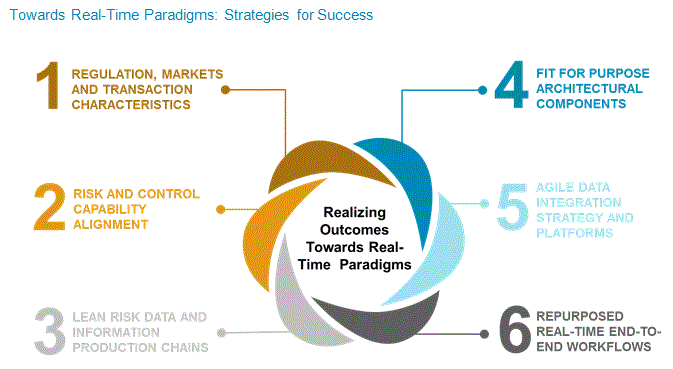
As firms build next-generation risk ecosystems, architectural considerations need to be carefully overlaid and aligned with strategic market, business, and regulatory requirements to arrive at successful outcomes.
“The financial industry is reaching a tipping point where necessity and obligations are catalyzing efforts to embrace the promise of greater automation, digitization of business processes, and availability of technology-enabled service provision around the clock,” says Cubillas Ding, a research director with Celent’s Securities & Investments practice and author of the report. “The industry does not talk about real-time in explicit terms anymore. However, we believe that there is a silent revolution and transformational shifts around risk management technologies happening throughout the industry.”
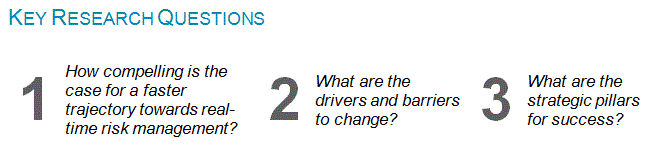
In this report, Celent examines the questions around real time and presents recommendations for financial firms and service providers to adopt smarter approaches to harness and exploit its full potential. This 24-page report contains 9 figures and tables.