
Hidden Costs in Modern Core Insurance Systems

by Craig Beattie, December 22, 2010
Insurance > Life > Core Systems
Insurance > Life > Life-Health Insurance
Insurance > Life > Misc
Insurance > Property-Casualty > Core Systems
Insurance > Property-Casualty > Misc
Insurance > Property-Casualty > Property-Casualty Insurance

Abstract

At first glance, a core systems replacement project may look like open heart surgery, with all of the associated risks. The information processed and distributed by these systems is the life-blood of any insurer.

A number of best practices are forming regarding core systems replacements. In a new report, Hidden Costs in Modern Core Insurance Systems, Celent examines how to ensure that the project sets off in the right direction and continues on course, and also looks at establishing the new organisation when the project lands.

One of the key issues in adopting a modern core system is ownership. A modern system may allow business users to undertake key changes, such as changing customer documents, the customer-facing portal, or even business rules. This report offers guidance against the pitfalls and false assumptions that can creep into a cost-benefit analysis for the project and ultimately undermine the benefit realisation.
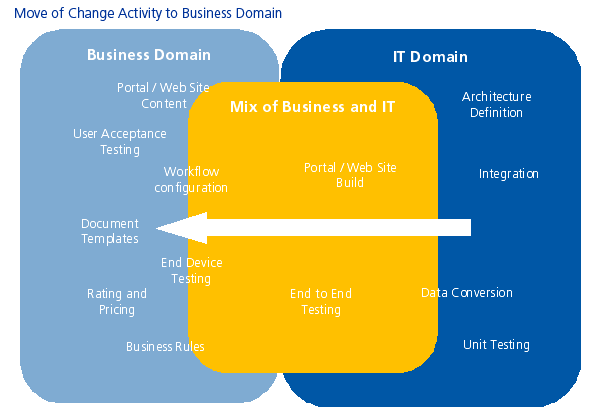


“In some projects, a minority of tasks are ‘IT only,’ but the majority require a mix of IT and business ownership,” says Craig Beattie, Analyst with Celent’s Insurance Group and author of the report. “It is no wonder that initial estimates of cost and level of involvement can lead to confusion. Costs often fall into the gap between IT and business.”

This report examines some of the hidden IT and non-IT costs involved in executing a core systems replacement program. It will leave the reader better able to judge the true value of a core systems replacement.

Celent is a research and advisory firm dedicated to helping financial institutions formulate comprehensive business and technology strategies. Celent publishes reports identifying trends and best practices in financial services technology and conducts consulting engagements for financial institutions looking to use technology to enhance existing business processes or launch new business strategies. With a team of internationally based analysts, Celent is uniquely positioned to offer strategic advice and market insights on a global basis. Celent is a member of the Oliver Wyman Group, which is part of Marsh & McLennan Companies [NYSE: MMC].

Media Contacts

North America (New York)
Dana Greenstein
dgreenstein@celent.com
Tel.: +1 646 364 8254

Europe (Stockholm)
Nick Bockh
nbockh@celent.com
Tel.: +46.8.650.4401

Asia (Tokyo)
Yumi Nagaoka
ynagaoka@celent.com
Tel.: +81.3500.3023

Table of Contents

Executive Summary

3

Introduction

4

You Have to Spend Money to Make Money

4

Establishing the Business Case

6

Soft and Hard Benefits

6

Benefits Case Model and Usual Assumptions

8

Project Cost Assignment Models

9

Moving Change from IT to Business

10

An Example Project Cost Assignment Model

12

Ancillary Functions

15

Can Your Infrastructure Take It?

16

Project Execution

18

Good Project Management Practice

18

The Cost of Phases

18

Scalability and Performance Testing

19

Establishing Interfaces

20

Going Live

20

Post-Implementation: Establishing the New Organisation

22

Governance Drives Cost More Than Ownership

22

The Analysis Gap

24

Testing

25

Support

25

How Many Folks Do I Need?

26

Final Thoughts

27

Leveraging Celent’s Expertise

28

Support for Financial Institutions

28


Support for Vendors

28

Related Celent Research

29